Our specialist stores
Our specialist stores




Edge Sealers
Edge sealers are designed for anyone who cuts, fits or installs sheet materials and wants a cleaner result. Whether it is a small DIY job or regular site work, exposed edges still need protection. Sealing them helps keep panels more stable over time. It is a simple step that fits into almost any project.
What is edge sealer?
An edge sealer is a liquid edge sealant used on the exposed edges of sheet materials such as MDF, plywood, chipboard and OSB. When boards are cut, the internal structure becomes open and more absorbent than the surface. These edges are the first areas to take in moisture and the first to show signs of damage.
To deal with this, a sealer is applied directly onto the cut edge. It does not sit on top like a coating but is drawn into the material itself. Once dry, the edge is less exposed and better protected against moisture getting in and causing gradual deterioration.
What is edge sealer used for?
Edge sealers are used wherever sheet materials are cut, fitted or exposed to conditions where moisture can reach the edges. In most cases, the need appears on site rather than on paper. As soon as a board is trimmed to size, the edge becomes the weakest point and requires protection.
One of the most common uses is for flooring and subfloor work. Chipboard and plywood are often cut during installation, especially around walls, pipes or uneven layouts. Treating these edges helps reduce swelling along joints and keeps the floor more stable over time.
They are also used in kitchen and bathroom projects where panels are regularly exposed to humidity and occasional water contact. Sealing exposed edges helps reduce the risk of softening, expansion and surface failure around cut-outs, joints and trimmed sections.
Joinery and furniture work is another area where edge protection makes a difference. MDF and similar boards have very absorbent edges, which can affect both durability and finish quality. Applying a sealer helps create a more controlled surface before painting, lacquering or further finishing.
One of the more specialised applications is butt joint sealing. When two freshly sealed boards are pressed together before the sealer has fully dried, the joint forms a watertight seal between the panels. This is particularly useful in flat roof systems, dormer construction and timber frame panel work, where exposed joints may be vulnerable during installation or temporary weather exposure.
Edge sealers are also commonly used in roofing and structural timber construction, where cut plywood edges are exposed on site before the building envelope is fully sealed. Applying sealer around exposed roof deck edges, structural panels and freshly cut joints helps reduce moisture ingress during storage, fitting and early construction stages.
Why choose our edge sealers?
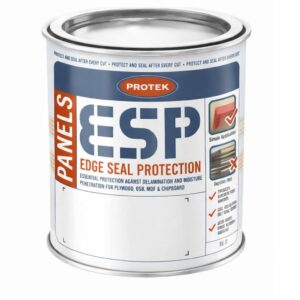
Not all edge sealers are formulated for sheet materials in the same way. Protek sealer is designed specifically for plywood and panel edges rather than being adapted from general timber end grain sealers. Freshly cut panel edges are more exposed to moisture than the surface itself, particularly on structural boards used on site. Rather than sitting on the surface like a simple coating, the sealer is absorbed into the exposed edge to help reduce moisture uptake and protect the internal bond of the board.
Performance has also been independently tested. Protek sheet sealer was tested by BM TRADA, a UKAS-accredited testing body, against uncoated plywood under 8 weeks of water submersion and 8 weeks at 81% humidity. Sealed edges retained glue bond strength with losses of only 0 to 4%, compared to 11 to 13% on uncoated boards. In practical terms, sealed edges held up roughly three times better than unsealed boards under prolonged moisture exposure. The coating also remained bonded after 72 hours in boiling water conditions.
The sealer can also be used for butt joint sealing applications. When two freshly sealed boards are joined together before the sealer has fully dried, the product helps create a watertight joint between panels. This makes it particularly useful where exposed plywood joints require additional moisture protection during installation.
Coverage is designed to stay practical on-site as well as effective. The recommended dry coverage rate is approximately 80 g/m², helping installers estimate quantities more accurately across larger projects or repeat jobs.
The sealer is available in three colours to suit different applications. Red is the standard formulation for exterior and structural use. It is the version tested by BM TRADA and the one most commonly used on roofing panels, timber frame builds and outdoor construction. The colour makes it easy to see where the sealer has been applied and where it has not. White and Clear are better suited to internal work such as kitchens, bathrooms and joinery, where a red-tinted edge would be visible after installation.
At Sheet Materials Wholesale, edge sealers are available at competitive trade prices with volume pricing on larger orders. Whether the boards are going straight to the site or arriving at home for a smaller project, fast UK delivery is available nationwide.
At Sheet Materials Wholesale, you can purchase Edge Sealers at low wholesale prices with fast nationwide delivery for most of items within 1-3 working days across the UK. Next-day delivery is also available on most orders. Competitive rates guaranteed.
FAQ
How long does edge sealer last once the container has been opened?
Once opened, edge sealer does not have a fixed expiry date, but it will typically remain in good condition for 6 months or more as long as the lid is resealed properly after each use. Store the container in a cool, dry place away from direct sunlight and extreme temperatures to help maintain the product's quality between uses.
How much edge sealer do I need per sheet or per square metre?
There isn't one exact answer because every job is different. A few straight cuts on MDF won't use much. A full roof deck with lots of exposed plywood edges will get through more quickly. As a rough guide, coverage is around 80 g/m² dry.
Can I paint or varnish over the sealed edge?
Yes, that's pretty standard. Most people seal the edge first, leave it to dry, then paint or lacquer over it afterwards. It also helps stop MDF and plywood edges from pulling in too much finish and drying unevenly.
How long should I leave edge sealer before fitting the boards or exposing them to moisture?
Touch dry within around 2 hours, depending on drying conditions and humidity. Allow the sealer to dry properly before installation or exposure to moisture. Cold, damp or poorly ventilated conditions can extend drying time.
Can edge sealer be used on freshly cut board edges?
Yes, that's what it's mainly for. Once the board's been cut, the inside edge is open and absorbs moisture far more easily than the original factory surface.
Is edge sealer suitable for exterior or structural plywood?
Yes. It's used a lot on structural and exterior plywood, especially where cut edges are exposed during storage, fitting or construction work. Common jobs include roofing panels, timber frame projects and structural board installations.
Where to buy edge sealers?
You can order edge sealers directly from Sheet Materials Wholesale online. The next day, UK delivery is available on selected orders, so you won’t have to wait around.
Edge Sealers Range
Showing all 2
Products in Edge Sealers
-
1L ESP Panel Edge Sealer – Plywood And OSB Edge Protection
1 Litre Protek ESP Panel Edge Sealer keeps board edges dry and protected, reducing the risk of swelling, warping and damage over time. It’s simple to apply and cheap enough to make sure you get your sheets covered for longer.
£21.00£25.20Ex VATInc VAT Add to cart -
125ML ESP Panel Edge Sealer – Plywood And OSB Edge Protection
125ml Protek ESP Panel Edge Sealer keeps board edges dry and protected, reducing the risk of swelling, warping and damage over time. It’s simple to apply and cheap enough to make sure you get your sheets covered for longer.
From:£6.89£8.27£7.40£8.88Ex VATInc VAT Add to cart